RedTech at Ai4: Our Biggest Takeaways from Las Vegas
Article by Rebecca Mister, Co-Founder, RedTech Recruitment
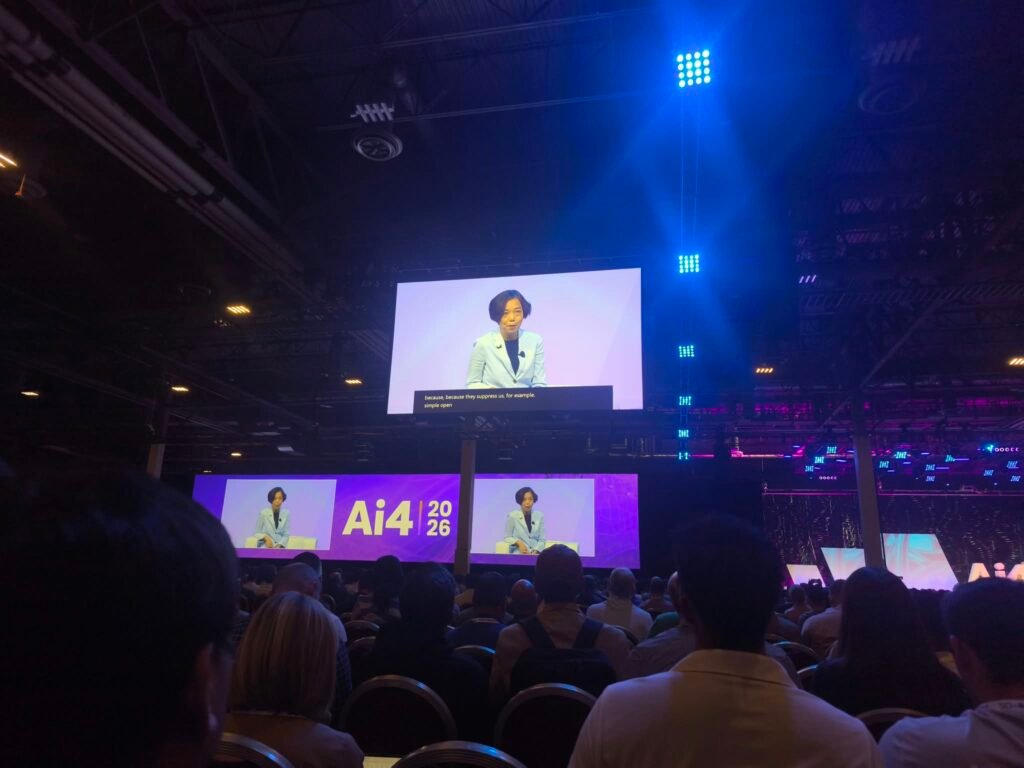
In August 2025, I flew to Las Vegas for Ai4, one of the world’s largest enterprise AI conferences. I went expecting a few interesting stats and maybe some good contacts. What I came back with was a head full of questions, conversations I haven’t stopped thinking about, and a much clearer sense of what AI actually means for hiring, work, and the tech industry right now.
Here are my biggest takeaways.
1. The biggest names in AI don’t agree on what the future looks like
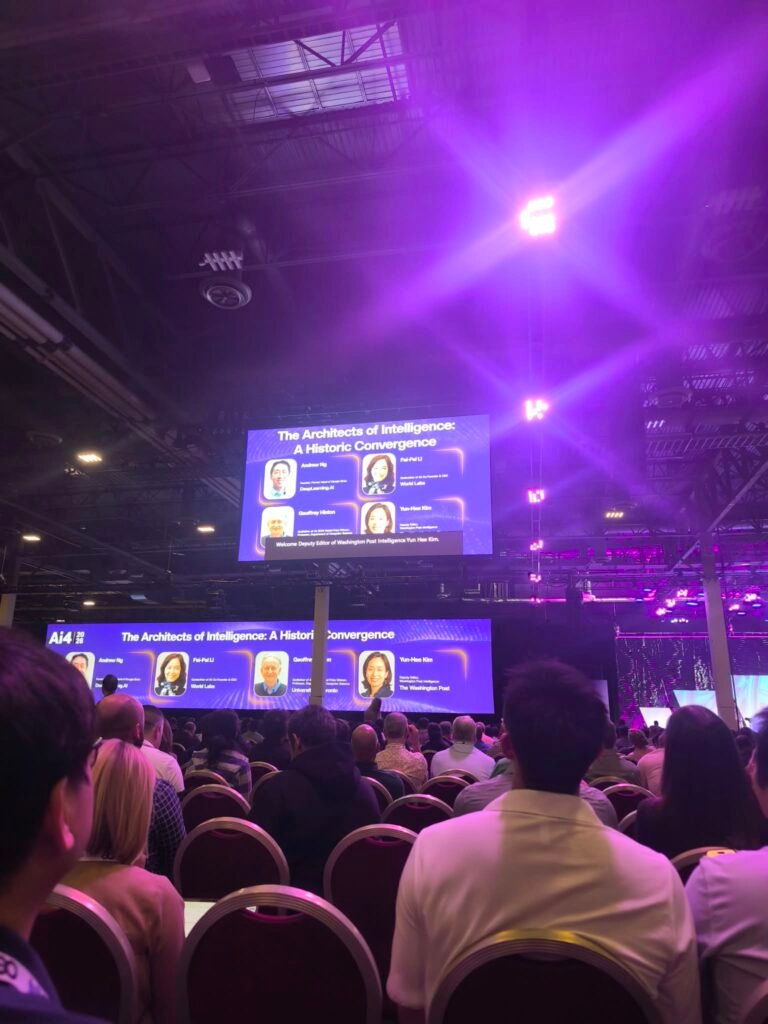
I don’t think I’ll ever forget sitting in a room listening to Geoffrey Hinton, Fei-Fei Li and Andrew Ng discuss the future of AI on the same stage. What surprised me most — and unsettled me a little — was how much they disagreed.
Hinton was the most cautious voice. Li and Ng were noticeably more optimistic. Everyone agreed that regulation matters, but Hinton put it best: “Regulation is a steering wheel, not the brakes.”
On jobs, the conversation was more measured than the headlines we’ve become used to. Fei-Fei and Andrew painted a far less dramatic picture than most media coverage suggests. Geoffrey was more cautious, saying he genuinely hopes that in five years we’re not talking about mass job losses — and he was quick to point out that he was the only person on the panel with no current financial stake in AI.
The conversation wasn’t about replacing everyone. It was about reshaping work, and making sure educators and policymakers are equipping the future workforce with the right skills. I haven’t heard nearly enough about what the UK is actually doing here, and that worries me. Curriculums need to start changing now, not after the fact — especially given the whole panel agreed that roles like call centre work will soon disappear, even as AI opens entirely new ones.
What stayed with me longest was the optimism about what AI could achieve if we get it right: improving access to education, eradicating illiteracy, accelerating scientific discovery, getting treatments to patients faster. Walking out of that keynote, I kept thinking about how important it is to separate the sensational headlines from the genuinely thoughtful debate happening in rooms like this one.
2. Everyone is becoming a builder — and that has big implications for tech hiring
This was the takeaway that felt most relevant to the work we do at RedTech, and the one I’ve thought about most since.
Across Ai4, again and again I heard the same story: businesses are putting AI coding tools into the hands of people who aren’t developers. People in Operations, Sales, Marketing and HR are increasingly able to describe a problem, give the right context, and build something that automates or improves a process themselves — without writing a single line of traditional code.
I spoke to a VP of AI who told me she’d recently replaced a SaaS product costing her business around $100,000 a year. She’d used AI to build an internal application that did what they needed in roughly an hour.
Obviously that’s not possible for every piece of software. Complex systems still need proper engineering, security, testing and ongoing support. But it made me wonder how many businesses are paying significant subscriptions for relatively simple tools they’ll soon be able to build themselves.
This came up in discussions around graduate recruitment too. One panel pointed out that graduates entering the workforce now can be incredibly valuable simply because many are already completely comfortable working with AI coding tools — they’ve learnt to build with AI from day one, rather than having to unlearn years of established practice. It’s something we’re seeing first-hand at RedTech. Nearly every role we’re recruiting for now expects candidates to be confident using AI coding tools, and the graduates who can demonstrate that are standing out.
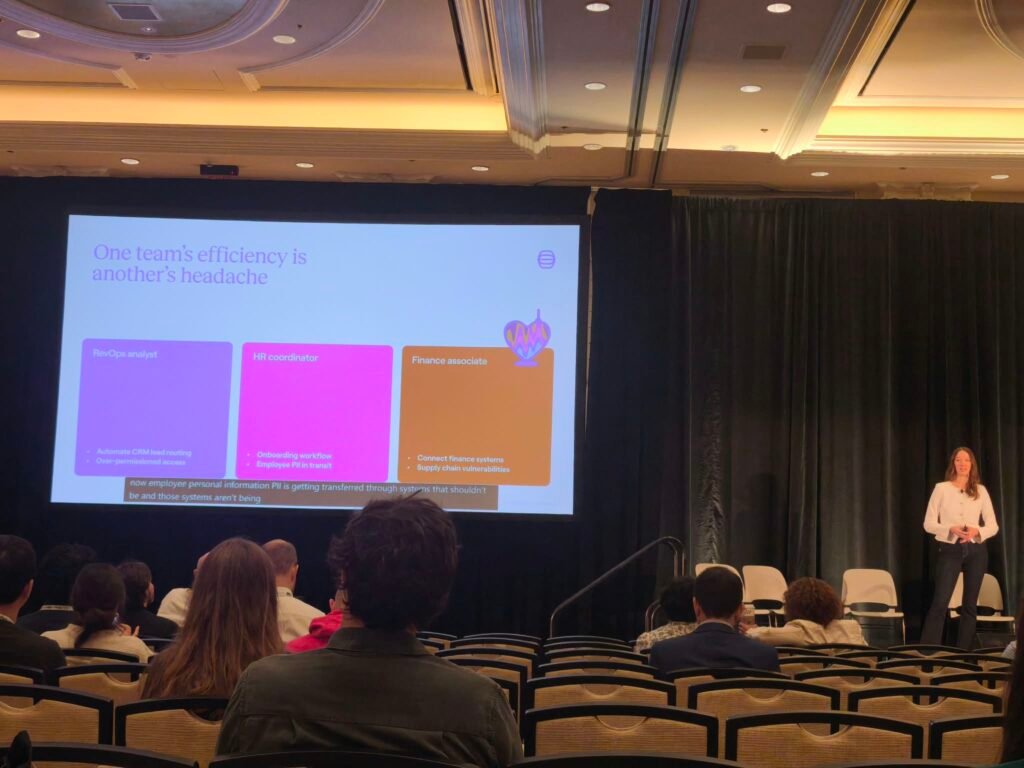
But there’s another side to all of this. If everyone in your organisation can suddenly build software and automate processes, who makes sure they’re building the right things, using the right data, and doing it securely? Guardrails and change management are becoming just as important as the technology itself — that was a recurring theme throughout.
I don’t think everyone is going to become a software engineer. But we’re entering a world where everyone has the potential to become a builder. And that has fascinating consequences for both the software industry and the jobs market.
3. The cost of AI nobody’s tracking
One thing I hadn’t thought enough about before Ai4 was the true cost of AI at scale.
Businesses that previously wouldn’t touch AI now want it embedded across their entire organisation. But according to several speakers, many have surprisingly little visibility of what they’re actually consuming. Every prompt, every agent, every AI-powered process uses tokens — and when thousands of employees and applications are involved, costs can escalate incredibly quickly. One example shared was a major company burning through its entire annual AI budget in a single quarter.
There’s already a whole new industry emerging to tackle this. I saw companies at Ai4 dedicated specifically to helping organisations understand and optimise their AI spend, giving businesses visibility of where costs are actually coming from rather than discovering them when the bill arrives.
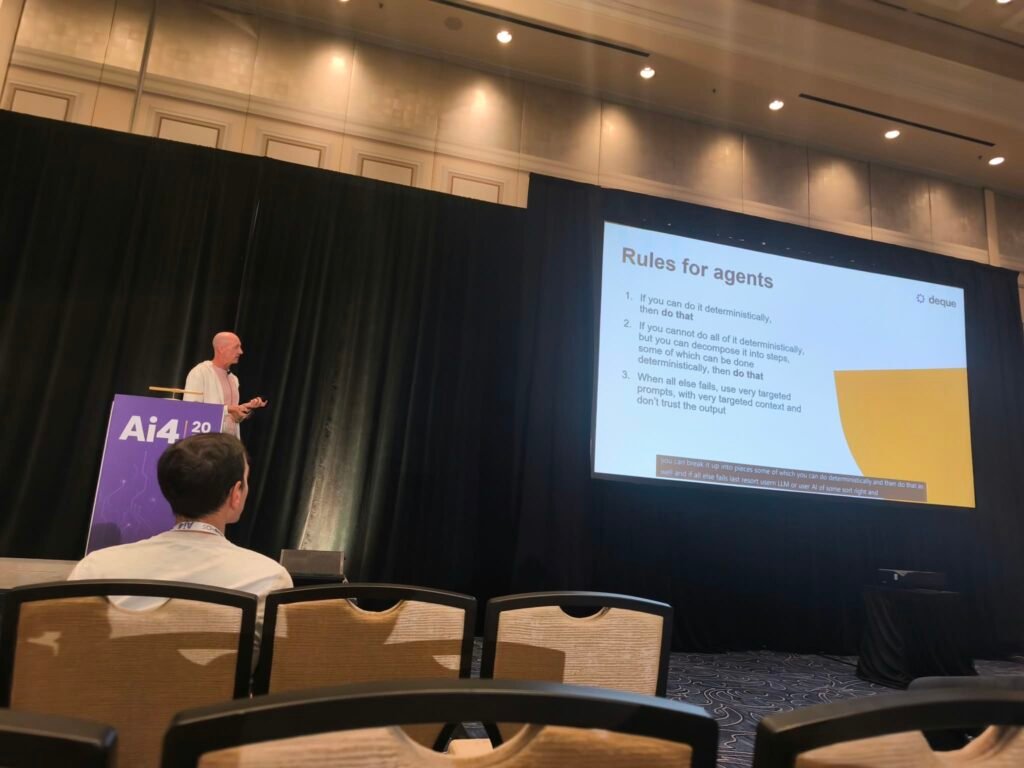
One speaker gave three rules for building with AI, and the first really stuck with me: if software can solve it deterministically, don’t use AI. It sounds obvious, but in the current rush to embed AI into everything, I’m not sure it always is.
Cloud computing eventually gave rise to FinOps as businesses realised they needed far better control of cloud expenditure. I wouldn’t be surprised if we see the same thing happen with AI — and soon.
4. Where were all the women?
One slightly disappointing observation from Ai4 was just how few women were there.
The main keynote room was enormous, filled with thousands of people. The Women in AI meetup was tucked away in a comparatively tiny part of the venue. I met some wonderful women there and had some of the best conversations of the whole event — but given the sheer scale of Ai4, the contrast was hard to ignore.
The tech workforce sits at around 20% female, so I wasn’t expecting parity. But this felt like even less than that.
What gave me some hope, though, was one of the clearest themes of the whole conference: AI could genuinely open the door for far more women to build technology. Speakers talked about how what it takes to build is changing. Increasingly, what you need is the ability to understand a problem clearly, give AI good context, ask the right questions, think critically about the output, and bring a different perspective to it.
That phrase — “the power is perspective” — has really stayed with me. If the barrier between having a great idea and being able to build it continues to fall, perhaps we’ll see many more women turning their ideas into products, automations and businesses, without needing to follow the traditional route into software development. I genuinely hope so.
(There was one small silver lining to the gender imbalance. I didn’t queue for the ladies’ toilets once. I did, however, see a queue for the men’s. Not quite the equality milestone I was hoping for — but hopefully in a few years I’ll be complaining about the queue instead.)
5. Could an AI win an Oscar?
One of the most enjoyable talks I saw came from Jack McCauley, co-founder and Chief Engineer of Oculus VR and Chief Engineer behind Guitar Hero. With that background, his predictions for the future of entertainment were fascinating.
He talked about how dramatically game development has already changed. When GTA V was in production just 12 years ago, recreating Los Angeles involved artists painstakingly crafting environments by hand over years. Today, you can describe an environment and AI can create it with remarkable detail.
His predictions for Hollywood went further still: AI-generated film sets, AI-generated actors, and — his boldest call — potentially an AI actor winning an Oscar.
His point wasn’t that human creativity disappears. It’s that where we add value changes. People who previously needed enormous teams and budgets to bring an idea to life may increasingly be able to focus on the story, concept and creative direction, while AI handles much of the execution.
I found this genuinely exciting to think about — and also, I’ll be honest, a little sad. There’s something about the human hand in filmmaking, the actors, the craft, the happy accidents on set, that I’d miss.
One of Jack’s slides summed up the shift perfectly. He showed a 1993 scene rendered on 20 Sun SPARC workstations that took six weeks to complete, frame by frame. At the same conference, I had a demo of Nvidia’s latest chip doing something comparable in moments.
That’s the pace we’re operating at.
What this means for tech hiring right now
Across five days and dozens of conversations, one thing kept coming back to me: the businesses getting this right aren’t just investing in AI tools. They’re investing in people who know how to use them well, question them critically, and bring the context and judgement that makes AI output actually useful.
That’s where RedTech comes in. Whether you’re looking for software engineers who are fluent in AI-assisted development, graduates who are experts building with these tools, or technical leaders who can help you navigate what all of this means for your team — we’re here to help you find them.
If you’d like to talk about your hiring plans for 2025 and beyond, get in touch.
[📞 +44 (0) 1223 782 488 | info@redtech-recruit.com]